
ARTICAL · AYURVEDA & MORDERN SCIENCE
Ayurveda, Dinacharya and the Science
of
Biological Rhythms
There is an intriguing connection between an ancient health tradition and a developing field of modern
biology.

Saikta Joshi
BAMS Student: 2nd Prof. Year | SGT University
Ayurveda has long emphasised the importance of when we wake, eat, work, exercise and sleep, and this principle is reflected in Dinacharya, the Ayurvedic framework for daily routine. Modern chronobiology explores biological processes that follow 24-hour rhythms and how these rhythms respond to environmental cues such as light, food, activity and sleep.
Ancient wisdom and modern science: different traditions, a shared truth — our bodies run on rhythms.
Dinacharya: health through daily rhythm
Ayurveda has long emphasised the importance of when we wake, eat, work, exercise and sleep, and this principle is reflected in Dinacharya, the Ayurvedic framework for daily routine. Modern chronobiology explores biological processes that follow 24-hour rhythms and how these rhythms respond to environmental cues such as light, food, activity and sleep.
Dinacharya combines Dina (day) and Charya (conduct or regimen). Classical Ayurvedic texts such as the Charaka Samhita and Ashtanga Hridaya describe structured daily practices involving waking, personal care, physical activity, meals, rest and sleep.
Ayurveda also explores the changing patterns of Vata, Pitta and Kapha throughout the day. These concepts belong to Ayurveda’s physiological framework and should not be seen as directly corresponding to modern biology.
Modern circadian science explores biological clocks that have an impact on sleep, hormones, metabolism and other physiological processes. The importance of these mechanisms was recognised by the 2017 Nobel Prize in Physiology or Medicine, awarded to Jeffrey C. Hall, Michael Rosbash and Michael W. Young for discoveries concerning the molecular mechanisms controlling circadian rhythms. The frameworks are different, but both take note of the relationship between biology and time.
How routine matters
Modern lifestyles can disrupt this relationship through irregular sleep, late-night light exposure, inconsistent meal timings, shift work and prolonged inactivity. Research increasingly explores the link between circadian disruption and sleep irregularity with metabolic and cardio-metabolic health.
Dinacharya approaches this from the angle of regularity – regular sleeping, eating and physical activity – offering an interesting point of comparison with modern research into sleep, circadian regulation and chrononutrition.
The Agni connection
In Ayurveda, Agni is linked to digestion and metabolism. Ayurvedic dietary principles consider not just what we eat, but factors such as quantity, suitability and timing. Modern chrononutrition asks a similar question: does when we eat impact how our bodies respond to food?
Research suggests that meal timing can affect metabolic processes, including glucose regulation and insulin responsiveness. This has sparked interest in approaches such as time-restricted eating, although the human evidence is still emerging. This is not to say that modern science has “proven” the Ayurvedic concept of Agni; rather, it offers a chance to explore whether some observations from Ayurveda have a measurable physiological counterpart.
From ancient practice to modern research
It would be wrong to say that modern science has proven Ayurveda, and biomedical science use quite different frameworks, concepts and methods, and not all Ayurvedic principles have a direct counterpart in modern medicine. The more useful approach is to place the two in conversation: Ayurveda offers a structured approach to daily life through concepts such as Dinacharya, and chronobiology offers science-backed approaches to exploring biological rhythms.
Our bodies run on rhythms. To understand those rhythms may help us think more critically about how we sleep, eat, work, move and recover.
THE SIMPLEST TAKEAWAY
REFERENCES
- Charaka, Charaka Samhita, Sutra Sthana, Ch. 5, Matrasiteeya Adhyaya, Chaukhambha Bharati Academy, Varanasi.
- Vagbhata, Ashtanga Hridaya, Sutra Sthana, Ch. 2, Dinacharya Adhyaya, Chaukhambha Sanskrit Sansthan, Varanasi.
- The Nobel Assembly, The 2017 Nobel Prize in Physiology or Medicine, NobelPrize.org, 2017.
- Mohawk, JA, Green, CB, Takahashi, JS, Central and peripheral circadian clocks in mammals, Annu Rev Neurosci, 2012;35:445-462.
- Panda, S, Circadian physiology of metabolism, Science, 2016;354(6315):1008-1015.
- McHill, AW, Butler, MP, Eating around the clock: circadian rhythms of eating and metabolism, Annu Rev Nutr, 2024; in press.
- Sutton, EF, et al, Early time-restricted feeding improves insulin sensitivity, blood pressure, and oxidative stress, Cell Metab, 2018;27(6):1212-1221.e3.
- Adafer, R, et al, Food timing, circadian rhythm and chrononutrition: a systematic review, Nutrients, 2020;12(12):3770.
SHLOKA OF THE MONTH
Imagine what you would do if you suddenly had everything you wanted but not the health to enjoy it. You have a successful career, financial security, a loving family, plans for travel and ambitions for the future. But then a persistent illness begins to dictate your day. Energy declines, sleep becomes difficult, work becomes exhausting, and even simple pleasures require effort.
We often ignore the luxury of being healthy, or treat it as just one of the items on our list of priorities. In this fast-paced world, in pursuit of education, careers, relationships, wealth and experiences, we somewhere along the way try to “fit in” our health. But perhaps we have got the order wrong.
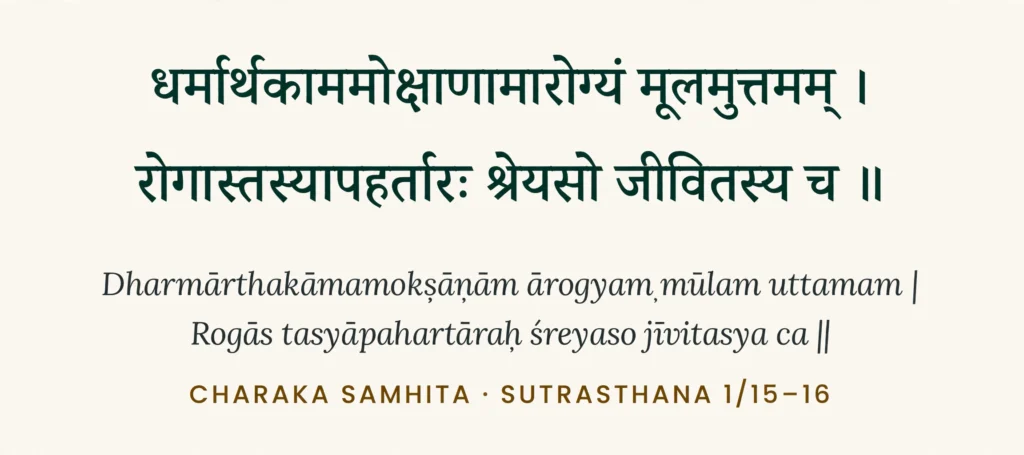
Health is the foremost foundation of Dharma, Artha, Kama and Moksa; disease takes away from well-being and from the very fulfilment of life. Perhaps the question is not simply “How can one avoid disease?” but “What kind of life do I want my health to make possible?” Health is not merely about adding years to life; it is about preserving the ability to work, love, experience, contribute, grow and find meaning in those years
Dharma
PURPOSE
Fulfilling our responsibilities
and having a sense of
purpose.
Artha
LIVELIHOOD
Earning a living, financial
stability, professional
growth and mental
security.
Kāma
FULFILMENT
Love, companionship,
creativity, leisure, pleasure
and meaningful life
experiences.
Mokṣa
FREEDOM
Freedom from excessive
attachment; inner peace.
Before we chase the goals of life, protect the foundation that makes them possible.
THE MESSAGE OF ANCIENT AYURVEDIC WISDOM
STUDENT VOICE · MY EXPERIENCE OF AYURVEDA
My Experience of Ayurveda
Reflections from my first professional year of BAMS
Devashish Sachan
1st Professional Student, Divya Jyoti Ayurvedic Medical College and Hospital, Modinagar, Ghaziabad
Entering BAMS and beginning my journey into Ayurveda has been a completely new and enriching experience. Before joining the course, I knew Ayurveda mainly as an ancient Indian system of medicine based on natural remedies, herbs and traditional methods of treatment. After entering the first professional year, I gradually realised that Ayurveda is much more than medicines and therapies. It is a complete way of understanding life, health, disease, food, lifestyle, and the relationship between the individual and nature.
My first introduction to Ayurvedic fundamentals
My first professional year introduced me to Sanskrit, Samhita and Siddhanta, Rachana Sharir, Kriya Sharir and other fundamental concepts of Ayurveda. Initially, some of these subjects felt difficult because the terminology and concepts were completely different from what I had studied before. Sanskrit, especially, was a new challenge. But with time, I understood that learning Sanskrit is not only about learning a language; it helps us understand the original meaning of Ayurvedic texts and prevents us from depending completely on translated material.
Understanding the basic principles
One of the most important things I have learned is the importance of the basic principles of Ayurveda. Concepts such as Tridosha, Panchamahabhuta, Dhatu, Mala, Agni, Prakriti and Srotas initially seemed like theoretical topics, but gradually I started connecting them with the human body and everyday life. Prakriti made me understand that every individual is different and therefore health cannot always be approached in exactly the same way for everyone. Similarly, Agni taught me that digestion and metabolism have an important role in maintaining overall health.
Learning the human body: Rachana and Kriya Sharir
Studying Rachana Sharir and Kriya Sharir has changed the way I look at the human body. Anatomy helped me understand the structural organisation of the body, while physiology helped me understand how different systems function. Learning Ayurvedic concepts alongside these subjects gave me a different perspective: I began to appreciate how Ayurveda attempts to understand the body as an interconnected system rather than looking at every organ in isolation.
For me, Ayurveda is no longer just a subject that I study for examinations.
DEVASHISH SACHAN
Ayurveda and the importance of prevention
Ayurveda gives great importance to prevention. Concepts such as Dinacharya, Ritucharya, proper diet, adequate sleep and healthy habits made me realise that maintaining health should not begin only after a person becomes ill. In today’s lifestyle, where irregular eating, stress, lack of sleep and sedentary habits are common, these principles feel especially relevant. Ayurveda has taught me to think about health not merely as the absence of disease, but as a balanced state of body, mind and daily life.
Learning beyond textbooks
My first professional year has also given me opportunities to learn beyond books. Participating in models, role plays, presentations, food-based projects and awareness programmes made learning more practical and enjoyable. These activities taught me communication, teamwork and confidence, and made me realise that being a good Ayurvedic physician requires more than academic knowledge. A physician must be able to communicate with people, understand their concerns and explain health-related concepts in a simple manner.
Connecting Ayurveda with society
One experience particularly influenced me: explaining Ayurvedic concepts to people through activities and public-awareness programmes. When we try to explain Shad Rasa, Panchamahabhuta or Tridosha to a common person, we realise that simply knowing a concept is not enough. We must understand it deeply enough to explain it in simple language. This has encouraged me to study Ayurveda not only for examinations but also to understand how its principles can be communicated responsibly to society.
Challenges and personal growth
The journey has not always been easy. Memorising Sanskrit terms, understanding classical concepts and managing different subjects together can sometimes feel overwhelming, and there are moments when I feel that there is a lot more to learn than I had imagined. However, these challenges have also taught me patience and consistency. Becoming a physician is a gradual process, and the foundation built during the first professional year will remain important throughout my career.
How Ayurveda has changed my perspective
The most valuable change is in my way of thinking. Earlier, I often looked at health mainly from the perspective of disease and treatment. Now I look at health from the perspective of balance, prevention, lifestyle and individuality. Ayurveda has encouraged me to observe the body and its functions with greater curiosity and to appreciate the importance of simple daily habits.
Looking ahead
As a first-professional BAMS student, I know that I am only at the beginning of this journey. I still have many Samhitas to understand, many concepts to learn and much more practical knowledge to gain. But my first year has given me something very valuable – a foundation and a new perspective towards health and life. I hope that as I progress, I will not only become better at understanding Ayurveda but also capable of applying its principles with scientific thinking, compassion and responsibility.
CONCLUSION
Ayurveda has become a way of looking at health, understanding individuality and appreciating the connection between lifestyle, nature and well-being. My journey has only begun, but the lessons of my first professional year have made me more curious, more aware and more determined to understand the science and philosophy of Ayurveda in depth.